Category: Mortgage Guidance

  • Buying a Home After Divorce: Mortgage Tips | Pike Creek Mortgages

    Buying a Home After Divorce: Mortgage Tips | Pike Creek Mortgages

    A single person reviewing mortgage documents at a clean kitchen table, symbolizing a fresh financial start after divorce

    Can I qualify for a mortgage after a divorce?

    Yes — you can qualify for a mortgage after a divorce, and many borrowers successfully do so within months of their divorce being finalized. Lenders evaluate your individual financial profile: your credit score, income, debts, and assets. What matters is the strength of your application as a solo borrower, not your marital history.

    At Pike Creek Mortgages in Newark, DE, our NMLS Licensed team works regularly with recently divorced buyers navigating this exact transition. The key is understanding which factors have changed and building a clean, documented financial picture before you apply.

    How does divorce affect my credit score and mortgage eligibility?

    Divorce itself does not appear on your credit report and does not directly lower your score — but the financial disruptions that often accompany it can. Missed payments on joint accounts, high balances carried during a separation, or accounts closed during asset division can all drag your score down at exactly the wrong time.

    Before applying, pull your credit reports and look specifically for joint accounts your ex-spouse may still be affecting. Even if a divorce decree assigns a debt to your spouse, lenders see you as legally liable until that account is paid off or refinanced out of your name. Dispute any errors promptly, and consider a credit review with a loan officer before you begin house hunting — as covered in our guide to improving your credit before applying for a mortgage.

    What income counts when I apply for a mortgage after divorce?

    After divorce, lenders count only the income you can document as your own — your W-2 wages, self-employment income, investment returns, and, critically, any alimony or child support you receive. To use support payments as qualifying income, most loan programs require that payments have been received consistently for at least 6 months and are documented to continue for at least 3 more years.

    If you were previously a non-working or lower-earning spouse, this is often the biggest hurdle. A letter from your family law attorney confirming the payment terms, combined with 6 months of bank statements showing deposits, is typically what lenders need. If your support income falls short, some buyers pursue a co-borrower arrangement or look at lower price points until their individual income stabilizes.

    How does the divorce settlement affect my debt-to-income ratio?

    Your debt-to-income (DTI) ratio — the percentage of your gross monthly income consumed by debt payments — is one of the most important numbers a lender will calculate, and divorce settlements can push it in either direction. If you were awarded the marital home and assumed the existing mortgage, that payment now sits entirely on your DTI. If you were assigned credit card balances or a vehicle in the settlement, those count too.

    Most conventional loan programs prefer a DTI below 45%, and FHA loans allow up to 57% in some cases with compensating factors. If your post-divorce DTI is too high, paying down revolving balances or waiting until joint debts are refinanced out of your name can make a meaningful difference. Pike Creek Mortgages can run a DTI analysis before you formally apply so there are no surprises at underwriting.

    Do I have to wait a certain amount of time after divorce to buy a home?

    There is no universal waiting period just because you are divorced — but the divorce must be legally finalized before most lenders will approve a mortgage. A separation agreement alone is not enough; underwriters want to see the final divorce decree so they can accurately assess your individual liabilities, any support obligations you owe, and your legal right to any assets you plan to use for a down payment.

    If you received cash from a home sale or a retirement account distribution as part of the settlement, those funds can often be used immediately — but you will need to document their source thoroughly. A lender experienced with post-divorce transactions, like Pike Creek Mortgages serving Newark and the surrounding Delaware communities, knows exactly what paper trail underwriters will request.

    What are the best loan options for buying a home after divorce?

    The right loan type depends on your credit profile, available down payment, and income picture after the settlement. The most common options for recently divorced buyers include:

    • FHA loans — Require as little as 3.5% down and accept credit scores as low as 580, making them accessible if your credit took a hit during the divorce process.
    • Conventional loans — Generally require a minimum 620 credit score and down payments starting at 3%; private mortgage insurance (PMI) drops off once you reach 20% equity.
    • VA loans — If you are a qualifying veteran or active-duty service member, VA loans offer 0% down and no PMI, and divorce does not affect eligibility as long as you individually meet service requirements.
    • USDA loans — Available in eligible rural and suburban areas of Delaware with 0% down for qualifying income levels.

    See our full guide to loan program comparisons for a deeper breakdown of which product fits different financial situations.

    What hidden costs and process steps should I expect when buying after divorce?

    Beyond the mortgage itself, buying a home as a newly single person involves costs and logistics that can catch first-time solo buyers off guard. Being prepared for these is as important as qualifying for the loan itself.

    • Closing costs typically run 2%–5% of the purchase price on top of your down payment — for a $300,000 home, that is $6,000–$15,000 in addition to your down payment funds.
    • Reserve requirements — Many loan programs require you to show 2–6 months of mortgage payments in reserve after closing. If your liquid savings were divided in the settlement, confirm your reserve position early.
    • Title and ownership decisions — As a solo buyer, title vesting is straightforward, but if you plan to remarry or add a partner to the deed later, discuss the implications with a real estate attorney.
    • Updated budget modeling — A single income covering housing, utilities, and any support obligations is a genuinely different financial picture than a dual-income household. Make sure your comfortable price range accounts for the full cost of homeownership, not just the mortgage payment.

    Pike Creek Mortgages, based in Newark, DE, walks every post-divorce buyer through a full cost-to-close breakdown before they make an offer — so the numbers are clear before you are emotionally committed to a property.

    How do I handle a joint mortgage from my marriage when buying a new home?

    If your name is still on a mortgage from the marital home — even if your ex-spouse is living there and making payments — that debt counts against your DTI until it is refinanced, sold, or paid off. The divorce decree does not remove you from the mortgage in the eyes of a lender; only a refinance or a sale does.

    If refinancing the existing home out of your name is not yet complete, be transparent with your loan officer. In some cases, lenders will exclude the payment from your DTI if you can document with 12 months of bank statements that your ex-spouse has been making every payment independently. This is a program-specific guideline and not universally available, so ask explicitly before assuming it applies to your situation.

    This guide was prepared by Pike Creek Mortgages, an NMLS Licensed Lender serving Newark, DE and Delaware home buyers through every stage of life’s transitions.

    Frequently Asked Questions

    Can I use alimony or child support as income on a mortgage application?

    Yes, alimony and child support count as qualifying income if payments have been received consistently for at least 6 months and are documented to continue for at least 3 more years. You will need your divorce decree and bank statements showing the deposits to satisfy most lenders.

    Do I need to wait after my divorce is final before applying for a mortgage?

    There is no mandatory waiting period after divorce, but the divorce must be legally finalized before a lender can approve your loan. Most lenders require the final divorce decree to assess your individual liabilities and confirm ownership of any assets you plan to use for a down payment.

    What happens if my ex-spouse’s name is still on our old mortgage when I apply for a new one?

    That joint mortgage counts against your debt-to-income ratio until the property is sold or refinanced out of your name. A divorce decree alone does not remove you from the mortgage in a lender’s eyes. In limited cases, 12 months of documented payments made solely by your ex can allow the debt to be excluded, depending on the loan program.

    What credit score do I need to buy a home after divorce in Delaware?

    FHA loans — popular with post-divorce buyers — accept scores as low as 580 with a 3.5% down payment. Conventional loans generally require a minimum 620 score. If your credit dropped during the divorce, a loan officer at Pike Creek Mortgages can review your report and suggest targeted steps before you apply.

    How much money do I need saved to buy a home on a single income after divorce?

    Plan for a down payment of 3%–3.5% minimum depending on loan type, plus closing costs of roughly 2%–5% of the purchase price, plus 2–6 months of mortgage payments in reserve. For a $300,000 home, that could mean $25,000–$40,000 total out of pocket before factoring in any seller concessions.

  • Condo vs. Single-Family Home Mortgage Differences | Pike Creek Mortgages

    Condo vs. Single-Family Home Mortgage Differences | Pike Creek Mortgages

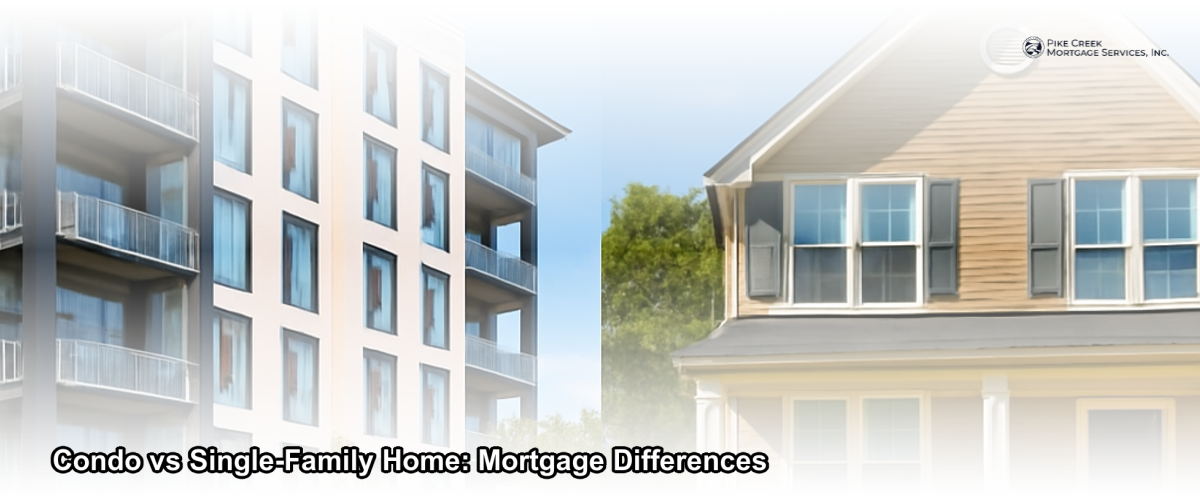
    Side-by-side view of a modern condo building and a traditional single-family home in a Delaware neighborhood

    What is the biggest mortgage difference between buying a condo and buying a single-family home?

    The single biggest difference is that lenders must approve not just you as a borrower, but the condo project itself — a requirement that does not exist for single-family homes. When you finance a single-family home in Newark, DE, your loan approval hinges on your credit, income, down payment, and the appraised value of the property. When you finance a condo, the lender adds a second layer of scrutiny: the homeowners association (HOA), the building’s financial health, its owner-occupancy ratio, and whether the project is on an approved list maintained by agencies like Fannie Mae or Freddie Mac.

    At Pike Creek Mortgages, our NMLS Licensed team walks Newark-area buyers through both paths every day — and the condo process consistently catches buyers off guard if they haven’t been briefed in advance.

    Why do lenders treat condo financing differently?

    Lenders treat condo financing differently because the unit you’re buying shares structural and financial risk with every other unit in the building — risk they cannot control once the loan closes. If the HOA is underfunded, litigation-prone, or heavily weighted toward investor-owned units rather than owner-occupants, the lender’s collateral is exposed to problems you personally did nothing to create.

    Conventional loans backed by Fannie Mae and Freddie Mac require that at least 50% of units in a project be owner-occupied for standard approval — some projects require 70%. FHA loans add additional requirements, including a project-level certification that the entire building meets agency standards. No such project-level approval process exists when buying a single-family home.

    How does the down payment requirement differ for a condo versus a single-family home?

    Down payment minimums are often higher for condos than for comparable single-family homes, depending on loan type and project classification. For a conventional single-family purchase, qualified buyers can put down as little as 3% with strong credit. For a conventional condo, the minimum is typically 3% for a Fannie Mae-warrantable project, but non-warrantable condos — those that fail occupancy, litigation, or financial reserve tests — frequently require 10% to 25% down or more, and may only be available through portfolio lenders at higher interest rates.

    FHA condo loans require a minimum 3.5% down payment, but only for projects on FHA’s approved condo list. VA condo loans require 0% down for eligible veterans, again subject to project approval. Single-family homes under FHA and VA have no project-level approval step — only the property appraisal and condition standards apply.

    What is a warrantable versus non-warrantable condo, and why does it matter for your mortgage rate?

    A warrantable condo meets Fannie Mae and Freddie Mac’s eligibility guidelines, meaning the loan can be sold on the secondary mortgage market — which translates directly into lower interest rates for the buyer. A non-warrantable condo fails one or more of those guidelines and must be financed through a portfolio lender who holds the loan in-house, typically at interest rates 0.5% to 1.5% higher than a conventional warrantable loan on a comparable single-family home.

    Common reasons a condo project becomes non-warrantable include: a single entity owning more than 10% of units, active litigation involving the HOA, commercial space exceeding 35% of the building’s square footage, or reserve funds below the agency-required threshold. None of these conditions apply to a standard single-family home purchase.

    • Warrantable condo: meets agency guidelines, conventional rates available, easier financing
    • Non-warrantable condo: fails one or more agency tests, portfolio lender required, higher rates and stricter terms
    • Single-family home: no project-level classification, rates driven by borrower profile and market conditions only

    How do HOA fees affect your mortgage qualification when buying a condo in Delaware?

    HOA fees count directly against your debt-to-income (DTI) ratio, which affects how much home you can qualify for — and this is an expense that single-family home buyers typically do not face (or face at much lower levels). In Delaware, condo HOA fees commonly range from $150 to $600 per month depending on building amenities, age, and location, and every dollar of that fee reduces your maximum qualifying loan amount.

    For example, a buyer qualifying for a $350,000 single-family home loan might qualify for a noticeably smaller condo loan if the building carries a $400/month HOA fee — because that fee is treated identically to a recurring debt payment by underwriters. At Pike Creek Mortgages in Newark, DE, we run this calculation upfront so buyers know their real purchasing power in both property types before they start touring homes.

    What hidden costs or additional steps should condo buyers in Newark, DE expect?

    Beyond the project approval process, condo buyers should anticipate several steps and costs that single-family home buyers avoid entirely. Knowing these upfront prevents deal-killing surprises at the closing table.

    • HOA questionnaire fee: Lenders require a completed HOA questionnaire; HOAs typically charge $100 to $400 to produce it, and this cost usually falls on the buyer.
    • Condo rider on the mortgage: Your loan documents include a condo-specific addendum outlining your obligations under the HOA — review it carefully before signing.
    • Project approval timeline: If the project is not already on an agency-approved list, the approval process can add 2 to 4 weeks to your closing timeline.
    • Special assessments: If the HOA has pending or recent special assessments for major repairs, lenders may require those to be paid off at or before closing, increasing your out-of-pocket costs.
    • Master insurance policy review: Lenders will verify that the HOA carries adequate master hazard insurance — a step that doesn’t apply to single-family purchases where you buy your own policy directly.

    For a full breakdown of closing costs across property types in Delaware, see our guide to understanding mortgage closing costs for Newark-area buyers.

    Is a condo or a single-family home easier to finance in Newark, DE?

    Single-family homes are consistently easier and faster to finance in Newark, DE because the approval process is limited to the borrower and the property — there is no project-level gatekeeping. That said, a warrantable condo in a well-managed building can move through underwriting smoothly and offer competitive rates, especially for buyers who want lower maintenance responsibility and proximity to areas like Pike Creek Valley or the Christiana area’s newer developments.

    The financing difficulty for condos scales with the project’s condition. A newer, owner-occupied condo community with healthy reserves and no litigation is a straightforward finance. An older high-rise with a large share of investor-owned units and an underfunded reserve account is a different challenge entirely. Pike Creek Mortgages recommends buyers ask for the HOA financials and meeting minutes before making an offer — not after — so there are no surprises when the lender’s project review begins.

    Which loan types are available for condos that aren’t available for single-family homes — and vice versa?

    Most conventional, FHA, VA, and USDA loan products are available for both property types, but with meaningful caveats. USDA rural development loans are available for eligible single-family homes in qualifying Delaware counties but are not available for condos. FHA loans require condo project certification, which limits availability to projects on HUD’s approved list — while FHA single-family loans face no equivalent restriction. VA loans for condos similarly require VA project approval, a separate list from FHA’s.

    Some renovation loan products, like FHA 203(k) loans, are available for single-family homes and some condos but are far more complex to execute in a condo setting due to HOA restrictions on structural changes. As your NMLS Licensed lender, Pike Creek Mortgages will confirm which products fit your exact target property before you’re committed to a purchase contract.

    This guide was prepared by the NMLS Licensed lending team at Pike Creek Mortgages, serving Newark, DE and the surrounding Delaware communities.

    Frequently Asked Questions

    Do condo loans have higher interest rates than single-family home loans?

    Not always — a warrantable condo in a well-managed project typically qualifies for the same conventional rates as a single-family home. However, non-warrantable condos that fail agency guidelines often carry rates 0.5% to 1.5% higher because they must be financed through portfolio lenders rather than sold on the secondary market.

    Can I use an FHA loan to buy a condo in Delaware?

    Yes, but only if the condo project is on HUD’s FHA-approved condo list. If the building isn’t already approved, your lender can apply for single-unit approval in some cases. Single-family homes financed with FHA loans have no project-level approval requirement.

    How do HOA fees affect how much I can borrow for a condo?

    HOA fees are counted as a recurring debt in your debt-to-income ratio, which directly reduces how much loan you qualify for. A $400/month HOA fee can meaningfully lower your maximum purchase price compared to a single-family home with no HOA.

    What makes a condo non-warrantable, and can I still get a mortgage?

    A condo is non-warrantable when it fails Fannie Mae or Freddie Mac guidelines — common reasons include a single investor owning more than 10% of units, active HOA litigation, or reserve funds below required levels. You can still get a mortgage, but it will come through a portfolio lender and typically at a higher interest rate.

    Does Pike Creek Mortgages finance both condos and single-family homes in Newark, DE?

    Yes. Pike Creek Mortgages is an NMLS Licensed lender serving Newark, DE and the surrounding area, offering financing for both condos and single-family homes across conventional, FHA, and VA loan programs. They review condo project eligibility upfront so buyers know their options before making an offer.

  • What Is a Second Mortgage? | Pike Creek Mortgages Newark DE

    What Is a Second Mortgage? | Pike Creek Mortgages Newark DE

    Homeowner reviewing second mortgage documents at a desk with a model house and financial paperwork

    What exactly is a second mortgage?

    A second mortgage is a loan secured against your home that sits behind your primary mortgage in repayment priority, allowing you to borrow against the equity you have already built up in the property. Because the lender of a second mortgage accepts more risk than the first mortgage lender — they are paid second if you default — interest rates on second mortgages are typically higher than on first mortgages, but still considerably lower than unsecured debt like credit cards or personal loans.

    At Pike Creek Mortgages in Newark, DE, we work with homeowners throughout New Castle County to evaluate whether a second mortgage fits their financial picture before they commit to any product.

    What are the two main types of second mortgages?

    The two primary forms of a second mortgage are a home equity loan and a home equity line of credit (HELOC), and they serve meaningfully different needs. A home equity loan delivers a lump sum at a fixed interest rate, with equal monthly payments over a set term — straightforward and predictable. A HELOC works more like a credit card: you draw funds as needed during a draw period, pay interest only on what you use, and then enter a repayment phase.

    • Home equity loan: Fixed rate, fixed term, lump-sum disbursement — best for defined, one-time expenses.
    • HELOC: Variable rate, flexible draws, interest-only payments during the draw period — best for ongoing or unpredictable expenses.

    Choosing between them depends on whether your borrowing need is a known amount or an open-ended one. Our loan officers at Pike Creek Mortgages walk through both structures with every client before recommending a path.

    How much can you borrow with a second mortgage in Delaware?

    Most lenders allow you to borrow up to 80% to 85% of your home’s appraised value across both your first and second mortgage combined — a figure called your combined loan-to-value (CLTV) ratio. For example, if your home is appraised at $350,000 and you owe $200,000 on your first mortgage, a lender allowing 85% CLTV would permit a second mortgage of up to $97,500 ($350,000 × 0.85 = $297,500 − $200,000 = $97,500).

    Your actual approved amount will also depend on your credit score, debt-to-income ratio, and the lender’s underwriting guidelines. Delaware borrowers with strong credit profiles and stable income typically qualify for the upper end of the available range.

    What does a second mortgage cost, and what hidden fees should you expect?

    Interest rates on second mortgages in today’s market generally run 0.5% to 2% higher than comparable first mortgage rates, though your exact rate depends on credit profile, CLTV, and the loan type. Beyond the rate, borrowers should budget for closing costs, which typically fall between 2% and 5% of the loan amount and may include an appraisal fee, title search, origination fee, and recording fees required by New Castle County.

    Some lenders offer no-closing-cost options by rolling fees into the rate — a trade-off that lowers upfront cash outlay but increases the total cost of borrowing over time. As an NMLS Licensed Lender, Pike Creek Mortgages is required to provide a Loan Estimate disclosing all fees within three business days of your application, so nothing should come as a surprise at closing. See our full guide to closing costs for a line-by-line breakdown of what Delaware borrowers typically encounter.

    When does taking out a second mortgage actually make sense?

    A second mortgage makes the most financial sense when you need to access a significant amount of capital at a lower interest rate than unsecured alternatives, and you have sufficient equity and stable income to support the additional payment. Common situations where this calculus works in the borrower’s favor include home renovations that increase property value, consolidating high-interest debt into a single lower-rate payment, funding education costs, or covering a large medical expense.

    It makes less sense when the loan funds a depreciating asset, when your income is unpredictable, or when the combined monthly payment would stretch your budget uncomfortably thin. Newark and the broader Wilmington metro area have seen steady home value appreciation over recent years, meaning many local homeowners have built more equity than they realize — making now a reasonable time to at least explore what is available to you.

    Does a second mortgage affect your primary mortgage or your credit?

    A second mortgage does not change the terms of your existing first mortgage — your original rate, payment, and servicer remain exactly as they are. However, it does add a new monthly obligation and a new tradeline to your credit profile. When you apply, the lender will run a hard credit inquiry, which may temporarily lower your score by a few points. Once the loan is open and payments are made on time, responsible management of a second mortgage can strengthen your credit mix and payment history over time.

    Delaware borrowers who are also considering refinancing their primary mortgage in the near future should be aware that an open second mortgage can complicate a cash-out refinance — a topic covered in our refinancing guide on the Pike Creek Mortgages site.

    What are the risks of a second mortgage you should understand before applying?

    The most significant risk of a second mortgage is that your home serves as collateral — if you cannot make payments, you can lose the property to foreclosure, even if you are current on your first mortgage. Second mortgage lenders have the legal right to initiate foreclosure proceedings, though in practice they rarely do so quickly given the subordinate position. Additionally, if home values decline, you could end up owing more than your home is worth across both loans, limiting your ability to sell or refinance.

    Variable-rate HELOCs carry the added risk of payment increases if interest rates rise — something Delaware homeowners who opened HELOCs during low-rate periods have experienced firsthand in recent years. Understanding your worst-case payment scenario before you draw funds is essential, and it is a conversation our licensed loan officers at Pike Creek Mortgages in Newark, DE prioritize with every HELOC applicant.

    How do you qualify for a second mortgage in Newark, DE?

    Qualifying for a second mortgage in Delaware generally requires a credit score of at least 620, though scores above 680 unlock significantly better rates and terms. Lenders will also evaluate your debt-to-income (DTI) ratio, typically requiring it to remain below 43% after the new payment is added, and will verify consistent income through pay stubs, W-2s, or tax returns if you are self-employed.

    An appraisal of your Newark-area property will be ordered to confirm current market value and calculate available equity. The full process from application to closing typically takes 3 to 6 weeks depending on appraisal scheduling and document turnaround. Pike Creek Mortgages, as an NMLS Licensed Lender serving Newark and New Castle County, can walk you through a pre-qualification review before you formally apply so you know where you stand.

    This guide was prepared by the licensed lending team at Pike Creek Mortgages, an NMLS Licensed Lender serving Newark, DE and the greater New Castle County area.

    Frequently Asked Questions

    What is the difference between a second mortgage and a refinance?

    A second mortgage adds a new loan on top of your existing mortgage without changing it, while a refinance replaces your current mortgage entirely with a new one. If you want to access equity without disturbing a favorable rate on your first mortgage, a second mortgage is usually the better choice.

    Can you get a second mortgage if you have bad credit?

    It is difficult but not impossible. Most second mortgage lenders require a minimum credit score of around 620, and scores below that will significantly limit your options or result in very high rates. Borrowers with lower scores may need to build equity above 20% to compensate, or wait until their credit profile improves.

    Is the interest on a second mortgage tax deductible?

    Interest on a second mortgage may be tax deductible if the loan proceeds are used to buy, build, or substantially improve the home securing the loan — but it is not deductible if the funds are used for personal expenses like debt consolidation or vacations. Consult a qualified tax advisor for guidance specific to your situation.

    How long does it take to get a second mortgage in Delaware?

    The process typically takes 3 to 6 weeks from application to closing in Delaware, depending on how quickly the appraisal is completed and how promptly documents are submitted. Having your income verification, homeowner’s insurance, and tax returns ready at the start can meaningfully shorten the timeline.

    What happens to a second mortgage if you sell your home?

    When you sell your home, both the first and second mortgage must be paid off in full from the sale proceeds at closing. If the sale price does not cover both balances, you would need to bring cash to the table or negotiate a short sale with both lenders — another reason to avoid over-leveraging your equity.