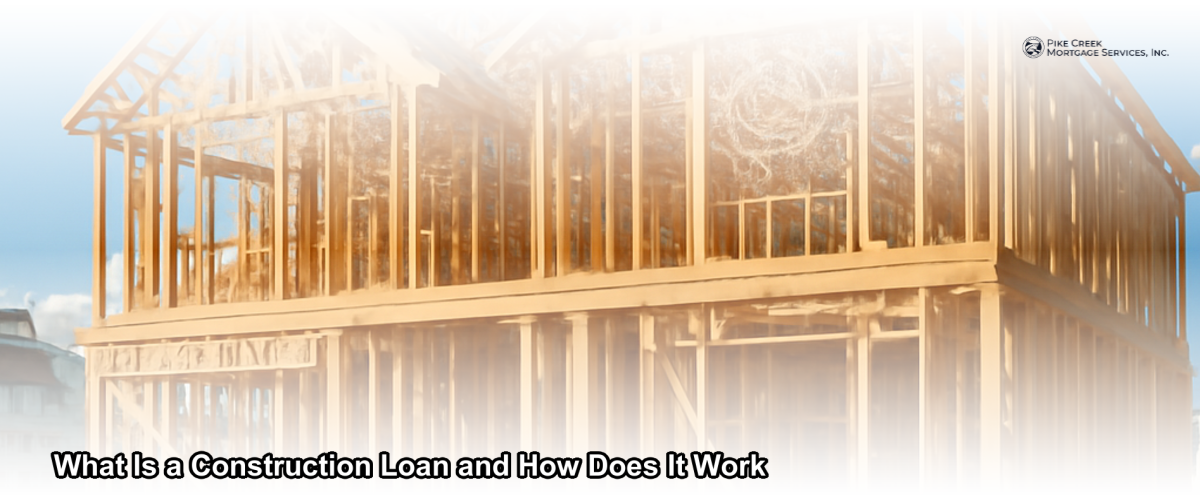
What is a construction loan?
A construction loan is a short-term, specialized mortgage that provides funding to build a new home from the ground up — or to complete a major renovation — rather than financing an existing property. Unlike a traditional mortgage, the money is not released all at once; it is disbursed in stages as construction milestones are reached. Pike Creek Mortgages, an NMLS Licensed Lender based in Newark, DE, helps borrowers navigate this process from the first blueprint review to the final draw.
Construction loans exist because lenders face more risk when there is no finished structure to use as collateral. The loan bridges the gap between breaking ground and the moment your home is ready to close as a permanent mortgage.
How does a construction loan work, step by step?
A construction loan works by releasing funds in scheduled increments — called draws — that correspond to verified stages of building progress, such as foundation pour, framing, rough mechanical work, and final completion. Here is the typical sequence:
- Application and approval: You submit plans, a builder contract, and a projected budget. The lender underwrites both you and the project.
- Loan closing: You close on the construction loan before a single nail is driven. At this point your rate and loan terms are established.
- Draw schedule: As each phase is completed, your builder submits a draw request. The lender may send an inspector to verify progress before releasing funds.
- Interest-only payments: During construction you typically pay interest only on the amount drawn so far — not the full loan balance — which keeps monthly payments lower while the home is being built.
- Conversion or payoff: When construction is complete, the loan either converts to a permanent mortgage (in a construction-to-permanent loan) or is paid off by a separate mortgage you take out at that time (in a standalone construction loan).
The draw process protects both the borrower and the lender by ensuring funds are tied directly to verified work — not spent ahead of schedule.
What is the difference between a construction-to-permanent loan and a standalone construction loan?
A construction-to-permanent loan — sometimes called a one-time-close or single-close loan — automatically converts into a standard mortgage when construction ends, meaning you only go through one closing, pay one set of closing costs, and lock your long-term rate at the start. A standalone construction loan, by contrast, is paid off entirely at completion, and you then apply for and close on a separate permanent mortgage — incurring two sets of closing costs but gaining flexibility to shop for permanent financing after your home is built.
For most borrowers building a primary residence in the Newark, DE area, the one-time-close structure simplifies the process significantly. Pike Creek Mortgages can walk you through both options to determine which fits your timeline and budget.
How much does a construction loan cost, and what are the rates?
Construction loan interest rates are typically 0.5% to 1.0% higher than conventional mortgage rates because of the added risk lenders take on an unfinished property. On a $400,000 construction loan at a rate of 7.5%, interest-only payments on a fully drawn balance would run approximately $2,500 per month — though early in construction, when only a portion has been drawn, actual payments are lower.
Beyond the rate, expect the following cost components:
- Closing costs: Typically 2%–5% of the loan amount, covering origination fees, title, appraisal, and more.
- Construction appraisal: Lenders order an appraisal based on the completed home’s projected value, which may cost $500–$1,000 or more depending on complexity.
- Draw inspection fees: Each draw may trigger a third-party inspection fee, often $100–$200 per visit.
- Contingency reserve: Most lenders require a contingency fund — typically 5%–10% of the construction budget — held in reserve for cost overruns.
As covered in any thorough review of new construction financing, the true cost is not just the rate — it is the full draw period, inspection schedule, and reserve requirements combined. Ask your loan officer for a full fee worksheet before committing.
What are the requirements to qualify for a construction loan?
Construction loans carry stricter qualification standards than conventional mortgages because lenders are underwriting both the borrower’s financial profile and the viability of the building project itself. Most lenders require a minimum credit score of 680–720, a debt-to-income ratio below 45%, and a down payment of at least 20% — though some programs allow as little as 10% to 15% down depending on loan type and borrower strength.
In addition to personal financial documentation, you will typically need to provide:
- Signed contract with a licensed, insured builder
- Detailed construction plans and specifications
- Itemized construction budget and draw schedule
- Proof of lot ownership or a simultaneous lot purchase contract
- Builder’s license and insurance certificates
Delaware does not impose state-specific construction lending restrictions beyond standard licensing requirements, but New Castle County permit timelines and inspection schedules can affect your draw schedule — something Pike Creek Mortgages factors into its pre-approval guidance for Newark-area borrowers.
How long does the construction loan process take in Newark, DE?
From application to closing, a construction loan typically takes 45 to 60 days — longer than a conventional mortgage primarily because of the additional underwriting required for the builder, the plans, and the project appraisal. The construction phase itself can run anywhere from 6 to 18 months depending on home size, builder availability, and permit timelines in New Castle County.
Weather is a real variable in the Newark, DE area: Mid-Atlantic winters with freeze-thaw cycles can delay foundation pours and exterior work, and lenders factor seasonal risk into draw schedule planning. Starting the loan process in late summer or early fall generally positions borrowers to break ground before conditions deteriorate. See our full guide to construction loan timelines for a month-by-month breakdown of what to expect.
What hidden costs should I watch for with a construction loan?
Several costs catch first-time construction borrowers off guard, and understanding them upfront is the clearest sign of a lender who is working in your interest rather than just closing a deal.
- Cost overruns beyond your contingency: If actual construction costs exceed your budget by more than your reserve covers, you may need to inject additional cash or renegotiate your loan — mid-project.
- Carrying costs during extended builds: Every month your construction period extends is another month of interest-only payments, rent (if you are living elsewhere), and storage costs.
- Re-lock fees: If your rate lock expires before construction completes, extending it typically costs 0.125%–0.25% of the loan amount or more.
- Duplicate closing costs: With a standalone construction loan, you pay closing costs twice — once at construction close and again when you take out the permanent mortgage.
- Change order markups: Builder change orders during construction are not covered by your original loan unless you formally request a loan modification, which may require a new appraisal.
Pike Creek Mortgages, serving Newark, DE and the greater New Castle County area, provides borrowers with a full cost-scenario worksheet at pre-approval so none of these figures arrive as surprises at closing.
Should I use a construction loan or buy an existing home?
A construction loan makes sense when you cannot find an existing home that meets your needs, when you want full control over layout, materials, and energy efficiency, or when you own land and want to build on it rather than sell. For many Newark-area buyers, the trade-off is between the certainty of a finished home’s appraised value and the flexibility — and higher upfront complexity — of building new.
Building costs in the Mid-Atlantic region have remained elevated, with residential construction running $150–$300 per square foot or higher depending on finish level and lot conditions — meaning a new build is rarely the lowest-cost path, but it can be the highest-value one when customization and long-term energy savings are factored in. If you are weighing both options, Pike Creek Mortgages can model both scenarios side by side so the comparison is grounded in real numbers for your situation.
This guide was prepared by Pike Creek Mortgages, NMLS Licensed Lender, serving Newark, DE and surrounding New Castle County communities.
Frequently Asked Questions
What is a construction loan and how is it different from a regular mortgage?
A construction loan is a short-term loan that funds the building of a new home in stages as work is completed, rather than releasing a lump sum upfront. Unlike a regular mortgage, you pay interest only on amounts drawn during construction, and the loan either converts to a permanent mortgage or is paid off with one when the home is finished.
How much of a down payment do I need for a construction loan?
Most construction loans require a down payment of at least 20%, though some programs accept as little as 10%–15% depending on your credit profile and the loan type. Requirements are stricter than conventional mortgages because the lender is underwriting both the borrower and an unfinished property.
What credit score do I need to qualify for a construction loan?
Most lenders require a minimum credit score of 680–720 for a construction loan. Borrowers with stronger scores and lower debt-to-income ratios will typically qualify for better rates and terms.
How long does a construction loan last?
The construction phase of the loan typically lasts 6 to 18 months. At completion, the loan either converts to a permanent mortgage automatically (one-time-close) or is paid off with a new mortgage. Getting to closing generally takes 45 to 60 days from application.
Can Pike Creek Mortgages help me get a construction loan in Newark, DE?
Yes. Pike Creek Mortgages is an NMLS Licensed Lender based in Newark, DE that offers construction loan guidance for borrowers throughout New Castle County, including help with builder review, draw schedules, and choosing between one-time-close and standalone construction loan structures.
Leave a Reply